
The Book on Off-Grid homestead Living
Off-Grid by Design
A complete guide to engineering your own self-sufficient mini homestead — from solar and wind to water, food, and warmth.
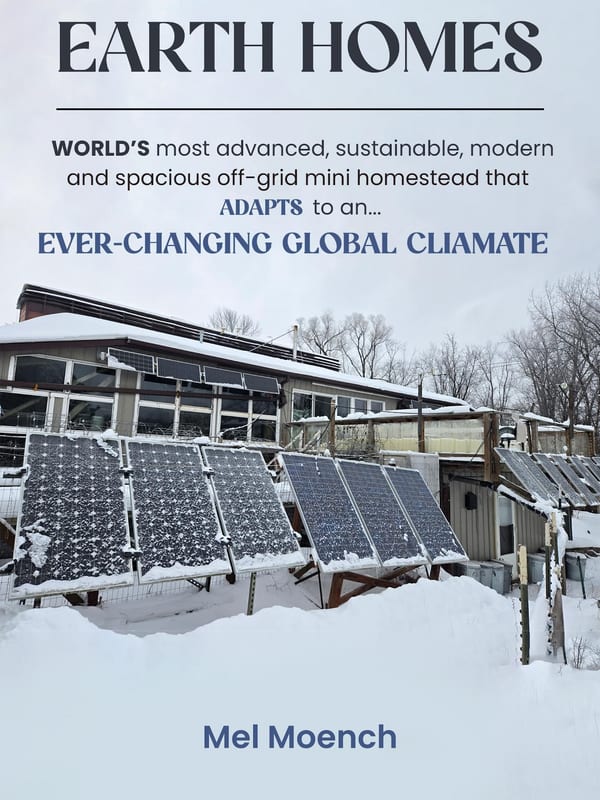
Now Available
Off-Grid by Design
What if you could build a home that produces everything it needs — and costs almost nothing to run?
After 51 years of engineering the world's most advanced off-grid mini homestead in Howard Lake, Minnesota, Earth Homes LLC founder Mel Moench wrote down everything. This book is the complete system: how he generates power, grows food, heats with wood, and lives free from utility bills — permanently.
What's Inside
Systems designed for complete Independence.
Solar & Wind Power
Efficiently sized, mounted, and oriented solar arrays, tilt-down wind turbine tower design, and battery bank wiring and control---plus a reliable back-up system that keeps the lights on.
Water Independence
Rainwater harvesting, advanced filtering, gravity-fed systems, and year-round water security.
Food Production
Cost-effepproctive raised beds, common storage areas, food preservation, and a growing plan for any location.
Heating & Shelter
Multi-use wood stove, passive solar built-in greenhouses, and efficient floor plan.
Waste & Sanitation
Efficient toilets, greywater systems, and closing the loop on every resource stream.
The Business Case
It has been thoroughly designed with cost in mind--including lower cost post-beam OVER Permanent Wood Foundation, and keeping an eye on maintenance and chore time.

About the Author
Mel Moench
Mel Moench is the founder of Earth Homes LLC and the engineer behind one of the most fully researched off-grid mini homestead systems. He has spent over five decades designing, building, and refining systems that let ordinary families live entirely off the grid — without sacrifice. He lives with his son in Howard Lake, Minnesota, where the homestead is still running, still improving, and still proving the concept every single day.
Book Review
Reviewed by Joseph Steckling
Overview
As a documentary I find it very detailed and informative. As an informational book on how you built an off-grid home large enough and complete enough to support a family, I find what you've accomplished credible, well thought out, and complete.
Earth Home is an ambitious, formal, systems-oriented book that treats the family home as a complete, near-autonomous living machine modeled on ecological principles. It documents Mel Moench's Earth Home Projects, launched in 1975 in the wake of the oil embargo, with the explicit goal of developing technology for mass-producible, food- and energy-independent shelters adaptable to any inhabited location while remaining ecologically compatible with local conditions.
The book is 280 pages, heavily illustrated, with extensive indexing — presenting a functional, efficient, need-oriented, durable, non-polluting, single-family "minimal existence living system built in the image of nature itself." It covers energy and power systems (renewables such as solar and wind), structure, heating/cooling, water capture/filtration/recycling, electrical power, diets and food production/storage/processing, appliances, and related practical topics.
Core Vision and Approach
Moench defines a modern self-sufficient home as one that aims to grow essentially all the family's food, generate its own power, recycle water and wastes, harvest and treat rainwater, and meet other needs within the home and immediate surroundings — while preserving a comfortable lifestyle familiar to industrialized societies rather than requiring radical lifestyle sacrifice. Special attention goes to efficient food production (disease-resistant open-pollinated plants, high feed-to-food-ratio animals), optimized storage/processing/cooking methods that save energy and labor, and thermal strategies such as earth cooling via circulated water and thermal mass buffering.
The philosophical and practical framing is driven by systemic vulnerabilities: fragile global food and commodity distribution networks, climate and weather instability, agricultural monocultures and hybrid-seed dependence, soil degradation, industrial diet problems, and the risks of political or infrastructural disruption. Moench argues that genuine security lies in greater household independence and that people should have a realistic option between full societal dependence and greater self-reliance.
He acknowledges that pure 100% self-sufficiency is technically unattainable due to component wear, occasional non-local materials, and certain inputs, but positions the design as a practical "mini-farm" or "food factory" that dramatically reduces external dependence. Research draws on earlier closed-system work and synthesizes traditional and emerging technologies into an integrated whole. Two prototypes were built and tested; a third planned and started. Earth Home functions more as a categorized reference surveying technology, products, and histories.
Strengths
The work's primary value is its holistic, engineering-minded integration. Rather than treating passive solar, rainwater harvesting, food production, or renewable power as isolated hobbies, Moench organizes them as interlocking subsystems of a single designed product that could, in principle, be adapted regionally and eventually mass-produced or kit-sized. The exhaustive resource compilation (indexes, product bibliographies, product/tech surveys) makes it a useful reference even decades later for anyone researching off-grid or high-self-reliance design.
Its Minnesota origins and practical engineering background lend a grounded, non-utopian tone focused on durability, efficiency, and comfort rather than aesthetic ideology. In the broader literature of sustainable or autonomous housing, it sits alongside — and in some ways anticipates aspects of — Earthship-style concepts, passive solar/earth-sheltered designs, and intensive food-production systems, while emphasizing a complete systems product approach and dietary/agricultural choices oriented toward resilience and nutrition.
Limitations and Context
Technology descriptions reflect the state of the art from the 1980s up to today. At this point, implementation complexity is high — integrating structure, thermal mass, water loops, food production, and energy systems into a reliable whole requires substantial skill, capital, and ongoing maintenance.
Commercial mass production of such fully integrated homes has not materialized at scale; the concept remains more a design reference and prototype-level achievement rather than a widely available product. Real-world food and energy self-sufficiency levels vary with climate, site, occupant skill, and labor input — however it is possible to mass-produce this style of home. The book is being positioned to be circulated primarily through specialized channels in hopes that someday it could be mainstream architecture or sustainability publishing.
Overall Assessment
Earth Homes is a substantial, earnest contribution to the literature of high-self-reliance and integrated ecological design. Its lasting interest lies less in any single technical innovation than in the disciplined attempt to treat the household as a closed or near-closed ecological and technological system that expands practical choices for independent living. For readers interested in resilient housing, intensive home food systems, or historical systems thinking about autonomy, it remains a dense, useful reference — best approached as a comprehensive design philosophy and resource compilation rather than a ready-to-build construction manual. Related works by Moench on renewable energy homes and historical/traditional diets further extend the same research thread.
Get Your Copy
Order directly from Earth Homes LLC. We fulfill every order personally.
+ $8.00 shipping & handling
You will be redirected to PayPal to complete your purchase securely. PayPal will collect your shipping address. We ship within 3–5 business days.
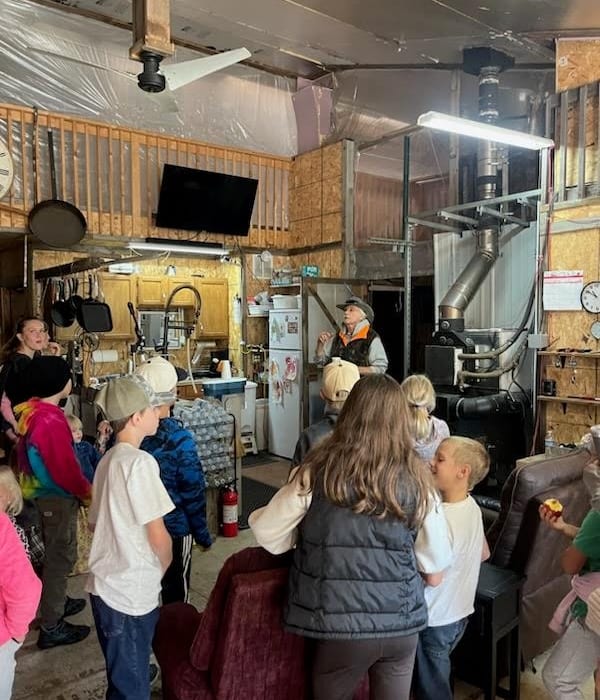
Ready to see it in person?
The book tells you how. The tour shows you the real thing.